Ceaușescu's Folly
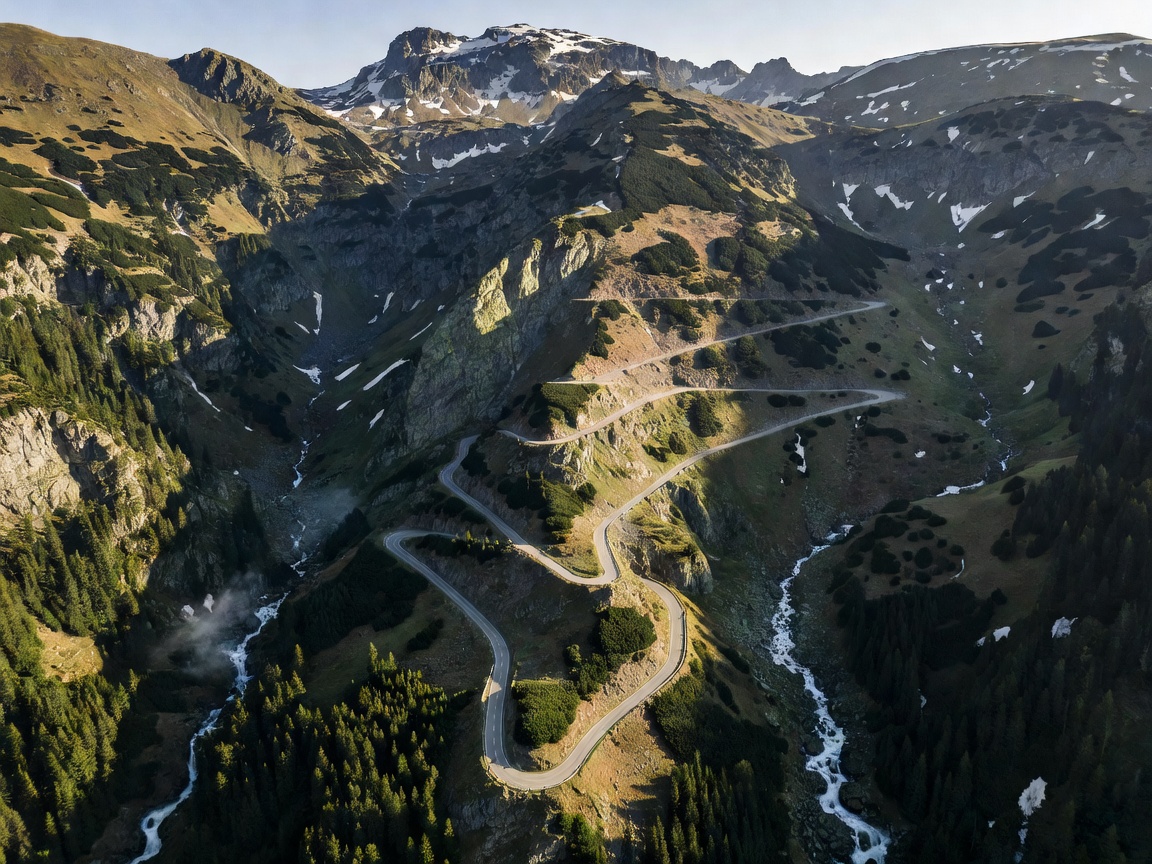
Constructed in the 1970s under the orders of Nicolae Ceaușescu as a strategic military route, the Transfăgărășan Pass (DN7C) violently carves its way through the highest sections of the Southern Carpathians. The northern ascent is a visual masterpiece, a seemingly endless cascade of S-bends and hairpin turns stacked upon each other like a draped ribbon. It is a road that forces the driver to constantly interact with the gearbox, punishing any vehicle lacking immediate throttle response.
Unlike the meticulously groomed Swiss passes, the Transfăgărășan possesses an undeniable raw, brutalist edge. Tunnels are unlit, rock faces sit inches from the tarmac without protective barriers, and the environment feels significantly more remote and untamed. It is a pilgrimage for the dedicated driving enthusiast, but it requires preparation and realistic expectations regarding the infrastructure.
Tarmac & Driving Dynamics
Surface quality is the primary limiting factor on the Transfăgărășan. While the lower sections are reasonably well-maintained, the high-altitude hairpins are battered by brutal winters. Potholes, frost heaves, and mid-corner gravel are common occurrences. A low-slung hypercar with zero suspension travel will be a miserable, damaging experience here. Front-axle lift systems are absolutely mandatory for negotiating some of the uneven transitions and improvised repairs.
The dynamic challenge lies in rhythm. The sheer density of corners means you rarely shift above third gear. Brake temperature management is less of an issue than in the Alps, as speeds are generally lower, but steering fatigue is a real factor. You are constantly wrestling the wheel from lock to lock. A quick steering rack and a lightweight front end offer a massive advantage on this route.
The Ideal Supercar Match
Nimble, mid-engined supercars with robust suspension tuning thrive on the Transfăgărășan. Vehicles like the McLaren 720S (utilizing its incredibly compliant Proactive Chassis Control) or a Porsche 911 Turbo S can absorb the road's imperfections without unsettling the chassis. Excessively wide vehicles, such as a Lamborghini Aventador, will feel terrifyingly compromised as the road narrows significantly in the upper switchbacks.
Practicalities & Considerations
The operating window for the Transfăgărășan is notoriously brief. Snow completely blocks the upper pass for the vast majority of the year. The route officially opens in late June and closes in late October, though freak snowstorms can force temporary closures even in August. The peak tunnel near Bâlea Lake is often damp, dark, and slippery regardless of the outside weather.
Due to its television-fueled fame, the road suffers from crippling tourist traffic. During mid-day in July or August, it operates as a sprawling, slow-moving parking lot. The only acceptable approach for performance driving is to arrive at the base of the northern ascent at first light. By 9:00 AM, the window of opportunity has slammed shut.
Wildlife is also a significant hazard. Stray dogs and, increasingly, brown bears frequent the roadside, completely oblivious to approaching vehicles. Maintain acute peripheral vision and avoid pushing the car to its absolute limits; the environment simply contains too many unpredictable variables.