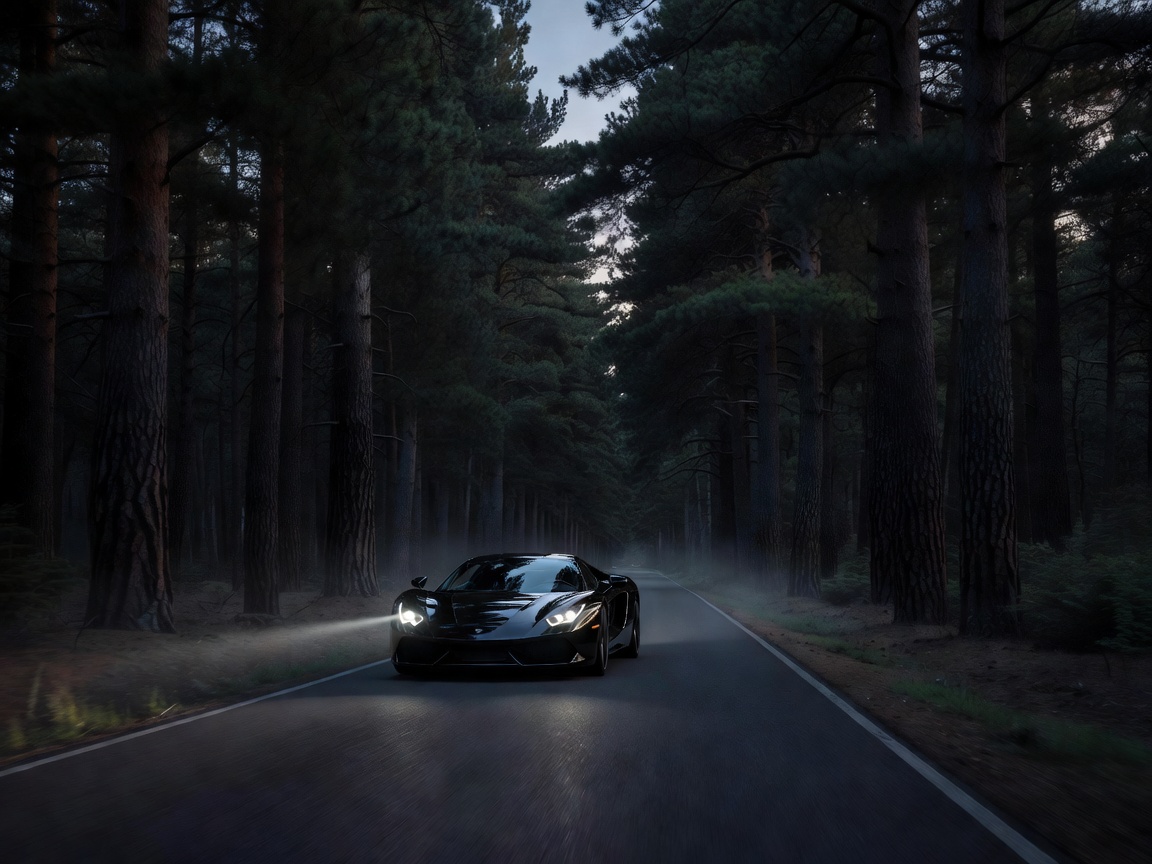
The Schwarzwaldhochstraße
Germany’s Black Forest region is steeped in folklore, characterized by towering, impossibly dense pines and rolling mountainous terrain. For the driving purist, however, the mythology centers entirely on the B500, specifically the Schwarzwaldhochstraße (Black Forest High Road). Stretching roughly 60 kilometers from Baden-Baden to Freudenstadt, this route completely eschews the hyper-technical hairpins found in the Alps in favor of something far rarer: long, ultra-fast, sweeping curves.
This topography dictates a distinctly different driving style. Instead of violent threshold braking and managing low-speed traction off the apex, the B500 is an exercise in managing weight transfer at high speeds. The road constantly undulates, compressing the suspension into the dips before unweighting over the crests. It is a mesmerizing rhythm that flatters a well-sorted chassis.
Tarmac & Driving Dynamics
The road surface across the B500 is typical of German infrastructure: utterly immaculate. The tarmac is remarkably smooth, void of the mid-corner bumps that can easily unsettle stiffly sprung vehicles. The lanes are generously wide, granting the driver multiple line choices through corners and providing ample margin for error. Sightlines are frequently spectacular; the road often rides the ridges of the forest, allowing you to see several corners ahead.
Connecting the various sections of the Black Forest often involves short stints on the Autobahn network. While the romanticized idea of restriction-free top-speed runs still exists on certain stretches, reality is often dictated by traffic density and dynamic speed limits. However, when clear, these transit sections allow hypercars and high-end GTs to stretch their legs in a legal, relatively safe environment that simply doesn't exist elsewhere in the world.
The Ideal Supercar Match
Tight, uncompromising track weapons like a Porsche GT3 RS will certainly perform here, but they are arguably overkill for the wide-radius turns. The Black Forest belongs to the front-mid-engine V12 Grand Tourers. Vehicles with long wheelbases, immense high-speed stability, and thunderous mid-range torque—think Ferrari 812 Superfast or Aston Martin DBS—are utterly sublime in this environment. The expansive roads mask their width, and the sweeping corners play perfectly to their aerodynamic strengths.
Practicalities & Considerations
The primary drawback of the B500 is its popularity. It is a legendary motorcycling route and a major tourist artery for campervans exploring the region. Undertaking the drive mid-morning on a summer weekend will invariably result in a frustrating, procession-like experience. To extract the true potential from the route, it must be driven early on a weekday morning or late in the evening during the extended twilight hours of summer.
Unlike the high Alpine passes, the B500 operates at a much lower elevation (peaking around 1,000 meters). This means weather conditions are far more stable, and the road remains open year-round, though winter brings heavy snow and requires specialized rubber. For high-performance summer tires, the prime operating window runs from late April through October.
Law enforcement maintains a presence, particularly during peak tourist seasons. While German speed limits on rural roads are generally higher than surrounding nations (often 100 km/h outside built-up areas), sudden reductions near junctions and viewpoint parking areas are strictly enforced with mobile speed cameras. Discipline and situational awareness are paramount.