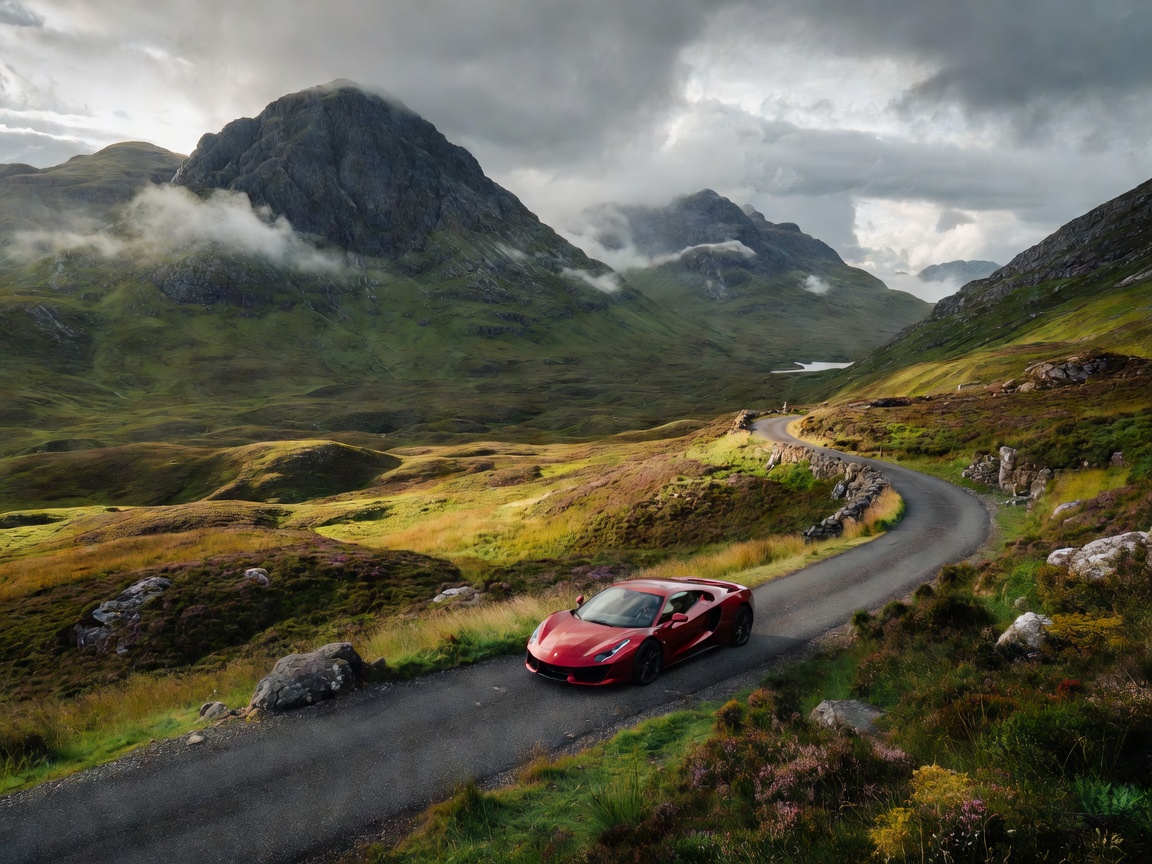
The Wild North Loop
The North Coast 500 (NC500) has rapidly established itself as the United Kingdom's premier touring route, stitching together over 500 miles of coastal roads and mountain passes starting and ending at Inverness Castle. However, grouping the NC500 with the wide, sweeping passes of the Alps is a fundamental error. The Scottish Highlands offer a vastly different, deeply untamed driving environment. It is isolated, atmospheric, and demands a highly specific approach to performance driving.
The route encompasses a massive variety of terrains, from the relatively smooth, high-speed coastal sweepers on the eastern leg to the claustrophobic, single-track ribbon of the infamous Bealach na Bà (Pass of the Cattle) on the Applecross peninsula. This pass features gradients of 20% and incredibly tight switchbacks built directly into the scree slopes, resembling an Alpine climb but scaled down to half the width.
Tarmac & Driving Dynamics
Surface quality is the defining challenge of the NC500. The tarmac across the northern and western seaboards is highly abrasive and violently undulating. It is heavily patched, prone to sudden dips, and frequently strewn with loose gravel from deteriorating verges. If your vehicle is set up with track-day spring rates, it will skip, hop, and tramline aggressively, making the car exhausting to drive and severely limiting your ability to deploy power.
Furthermore, much of the western route consists of single-track roads with designated passing places. This entirely eliminates the concept of 'flow.' You cannot chain a dozen corners together seamlessly; instead, you are constantly scanning the horizon, braking hard to tuck into a passing place for oncoming traffic. The dynamic challenge here is point-to-point acceleration and immense braking performance, rather than holding high G-forces through long corners.
The Ideal Supercar Match
Width is your absolute worst enemy in the Scottish Highlands. Ultra-wide hypercars will leave you sweating as you negotiate oncoming farm machinery with millimeters to spare. The perfect weapon for the NC500 is a compact, highly tractable sports car or entry-level supercar with a soft damper setting. A Porsche Cayman GT4 (with PASM set to normal), a Lotus Emira, or an Alpine A110 are spectacular here. Their narrow footprint allows them to use the entire lane, and their compliant chassis setups absorb the brutal tarmac rather than fighting it.
Practicalities & Considerations
Logistics require serious forethought. High-octane fuel (99 RON) is scarce once you leave Inverness; you must map your fuel stops rigidly, often relying on small, independently owned community pumps in remote villages. Range anxiety is a constant companion for V12 owners.
Weather is a defining characteristic of the experience. The Highlands can cycle through bright sunshine, torrential rain, and thick fog in a single afternoon, even in July. Your tires must be capable of evacuating standing water efficiently; aggressive semi-slick tires are a genuine liability in these conditions.
Finally, respect the local ecosystem and population. The NC500 passes through active agricultural land and quiet crofting communities. Sheep and deer frequently wander onto the road, presenting catastrophic collision risks. Keep noise levels respectful when passing through villages, and prioritize courtesy at the single-track passing places. The true joy of the NC500 is found in the immersion into the wild landscape, rather than chasing lap times.